Most of the conversation around clean hydrogen focuses on how to make it: green hydrogen from electrolysers powered by renewables, blue hydrogen from steam methane reforming paired with carbon capture, pink hydrogen from nuclear. Each pathway carries its own bottleneck, whether cost, infrastructure, or the upstream emissions it tries to offset.
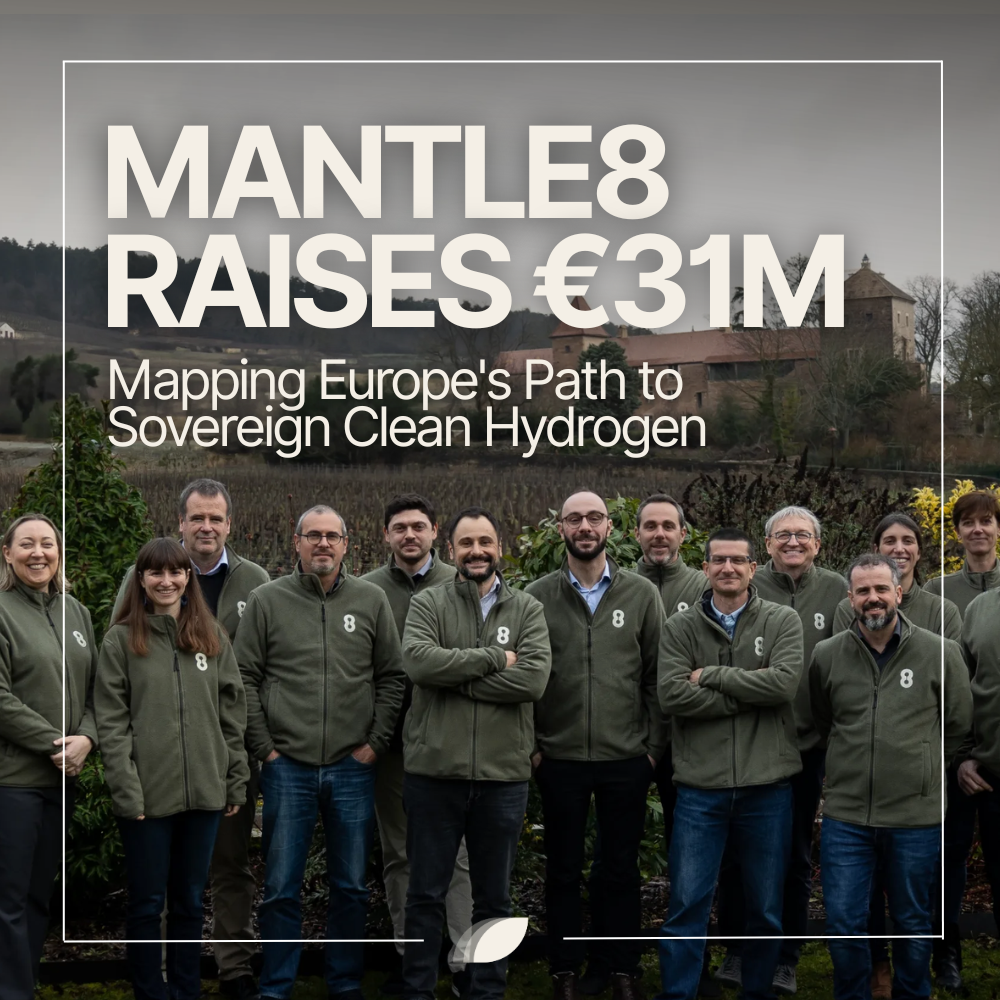
There is a fourth pathway that gets much less airtime, and we think that’s about to change: natural hydrogen, generated continuously by the planet itself, deep underground. Mantle8, which just closed its €31M Series A, is building the technology to find it at commercial scale. Here is why we joined the round.
The molecule Europe didn’t know it had
Hydrogen is already one of the most widely used industrial molecules in the world. Refineries need it. Ammonia production depends on it. Steel, chemicals, and the synthetic fuels that will decarbonise aviation all sit downstream of hydrogen supply. Today, around 90% of that supply is produced from natural gas, which means every kilo of industrial hydrogen comes with a direct carbon cost and a direct exposure to gas prices. In 2022, when European gas spiked, hydrogen followed.
Natural hydrogen offers something different. It is generated through serpentinisation: when iron-rich rocks deep in the Earth’s mantle come into contact with water under the right conditions, the reaction releases hydrogen as a byproduct. The process is continuous, exothermic, and active across geological timescales. The hydrogen migrates upward through faults and fractures, and where the right geological structures exist, it can accumulate.
This is not speculative chemistry. The mechanism is well-established. What has been missing is the ability to find commercially viable accumulations: pockets of high-purity, free-gas hydrogen, trapped in sealed reservoirs, at depths and volumes that can sustain industrial production.
Why this has been so hard for so long
The hydrogen molecule is small, light, and highly mobile. It escapes through almost anything that isn’t perfectly sealed. It reacts with organic matter, with carbon dioxide, with bacteria, and turns into methane if given the time. A reservoir that doesn’t trap the gas quickly enough is a reservoir you’ll never produce from.
Most of the natural hydrogen the industry has detected over the last decade has been observed as surface seeps: gas leaking out at ground level, suggesting something larger is happening below. The standard playbook has been to drill near those seeps and hope for the best. The results have been mixed at best. Surface signals tell you something is happening; they don’t tell you where the gas accumulates, how much of it is there, whether it’s in free-gas or dissolved form, or whether the reservoir is sealed.
Drilling without that information is expensive. A single exploration well runs into the tens of millions of euros. The sector has had no shortage of capital and no shortage of attempts, but no commercial flow has yet been confirmed anywhere in the world.
Mantle8’s bet: understand the system before you drill
What drew us to Mantle8 is that they have approached the problem from the other end. Rather than starting with surface signals and working backwards, they start with the geology and work forwards. Their proprietary exploration stack is built around a simple but demanding question: where in the world do the conditions for an active, sealed, free-gas hydrogen system actually exist, and how do you confirm that without drilling?
At the heart of that stack is HOREX®, which uses passive seismic sensing to listen for the micro-seismicity generated by the serpentinisation reaction itself. When rock reacts with water and releases hydrogen, it expands. That expansion generates measurable signals. Mantle8’s sensor networks pick up those signals, and combined with their broader subsurface modelling, they produce something no one else has demonstrated: the world’s first 4D imaging of an active underground hydrogen system.
This is the part that matters. Knowing that a system is active, where the hydrogen is accumulating, and whether it’s in extractable free-gas form changes the economics of exploration. It moves the decision to drill from a high-cost bet on indirect signals to a high-confidence call based on direct physical evidence. The €31M Series A is designed to deploy this stack across their global pipeline and to confirm commercial flow on a first prospect.
What this means for Europe
Mantle8 has modelled a natural hydrogen production cost of €0.80/kg. To put that number in context: European industrial hydrogen has rarely traded below €1.50/kg in the last five years, and electrolytic green hydrogen remains structurally above that level. If natural hydrogen can be produced at €0.80/kg at scale, it doesn’t just compete with grey hydrogen, it changes the economics of every downstream market hydrogen feeds into.
It also changes something else. Europe imports the vast majority of its energy. The molecules that power its industry, its mobility and its heating come from somewhere else, and that dependency carries a geopolitical cost we have all become more aware of over the last few years. Natural hydrogen, if proven, would be a domestically generated, low-carbon energy resource. It would sit underneath Europe rather than crossing its borders, and it would do so without needing the renewable electricity infrastructure or the import logistics that other clean hydrogen pathways require.
That alignment, between climate impact and strategic autonomy, sits at the centre of what we look for at Wind. Mantle8 is building the technology that determines whether this resource becomes part of Europe’s energy future or remains a scientific curiosity. We’re proud to back them, alongside Sandwater, Breakthrough Energy Ventures, Bpifrance Green Ventures, Kiko Ventures and Calderion, in the next phase of that work.
The next two years will tell us a lot. Mantle8 is moving from confirming that the science works to confirming that the resource is there. If they succeed, the conversation around clean hydrogen in Europe will look very different by 2028.